
MuseSourcing sources silicone products — kitchenware, baby feeding products and moulded household goods — from partner factories in our vetted supplier network in Shenzhen and Dongguan, Guangdong’s silicone moulding clusters. Buyers find this page looking for a silicone products manufacturer in China; what we add to that factory is the verification layer described below. Silicone is a material business before it is a product business: the same spatula shape can be moulded from a compound that passes food-contact testing or from a cheaper compound that smells, tears and fails food-contact testing, and the two are hard to tell apart in a photograph. Our checking starts with the material paperwork, not the finished piece. Once a factory passes verification, we coordinate samples, follow production, inspect finished goods and arrange consolidation and shipment.
Manufacturing hub: Shenzhen and Dongguan, Guangdong — where silicone material mixing, mould-making and moulding sit inside one cluster, and the partner factories we use mix their own compound and finish pieces by hand.
See all the clusters we work in: Products We Source
Key takeaways
- “Food grade” is a document claim before it is a product claim. The test report must match the material and the product being shipped — a report for a different compound or a different item covers nothing.
- Odour is a process tell. Properly post-cured food-grade silicone comes out nearly neutral; a strong smell on samples points to skipped post-curing or cheaper curing chemistry.
- Colour and finish drift quietly in silicone. Colour is approved on a physical sample and re-checked across the run, because the tenth carton rarely matches the first unless someone is looking.
What we source in this category
- Silicone kitchenware: baking moulds and mats, spatulas and utensils, stretch lids, funnels and food-storage items
- Silicone baby feeding products: bowls, bibs, spoons and teethers
- Moulded silicone household goods: ice trays, trivets and oven mitts, stretch lids and seals
- Custom (OEM/ODM) programmes: Pantone-matched colours, embossed or printed logos and private-label packaging; the same factories run wholesale silicone lines for kitchenware and baby brands
Real Factory Photos: Mixing and Finishing in Guangdong
Real partner-factory photos — not AI-generated or stock imagery.
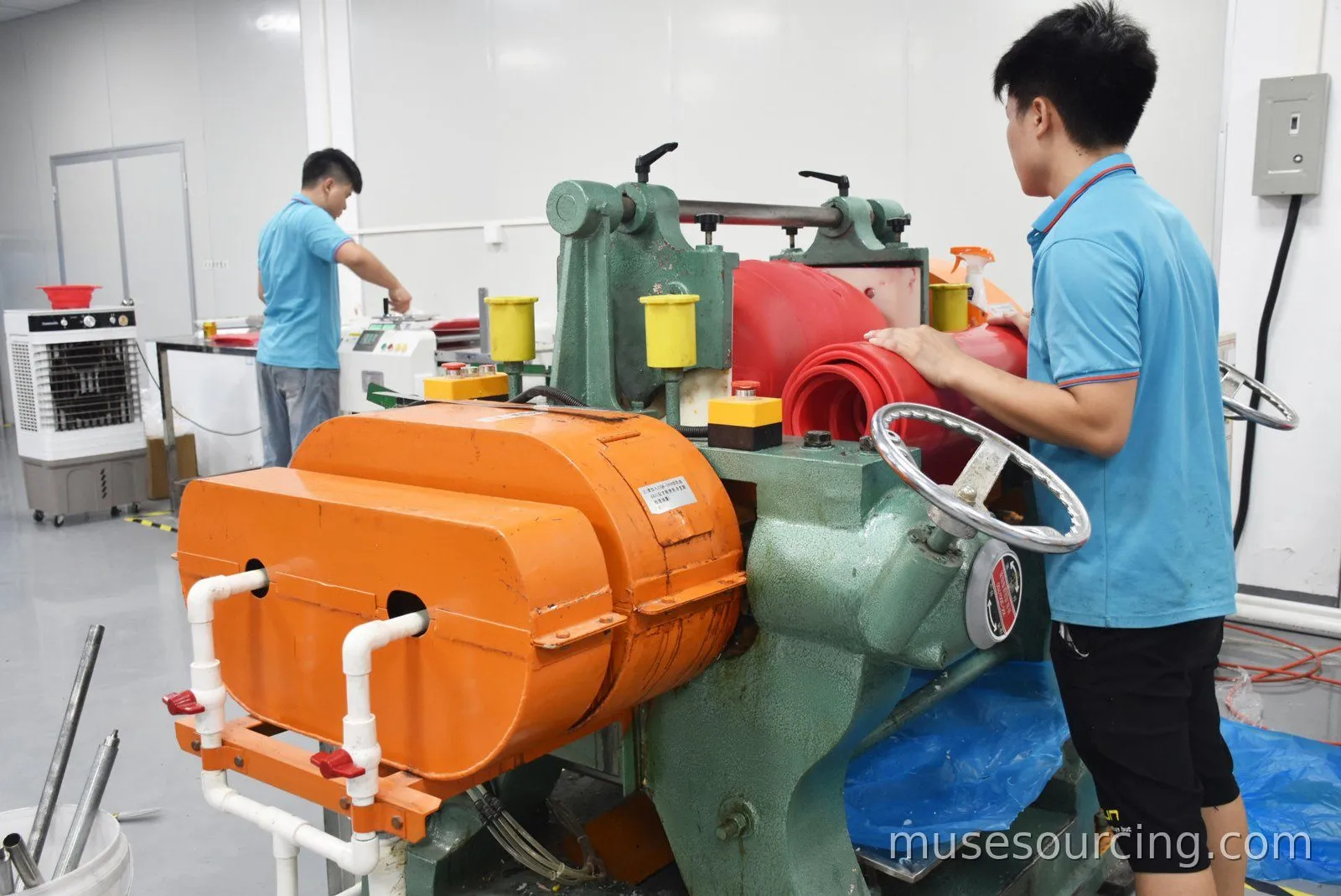
- Silicone rubber mixing mill: a worker milling coloured silicone compound — proof that material preparation happens in-house, where the food-grade claim starts.
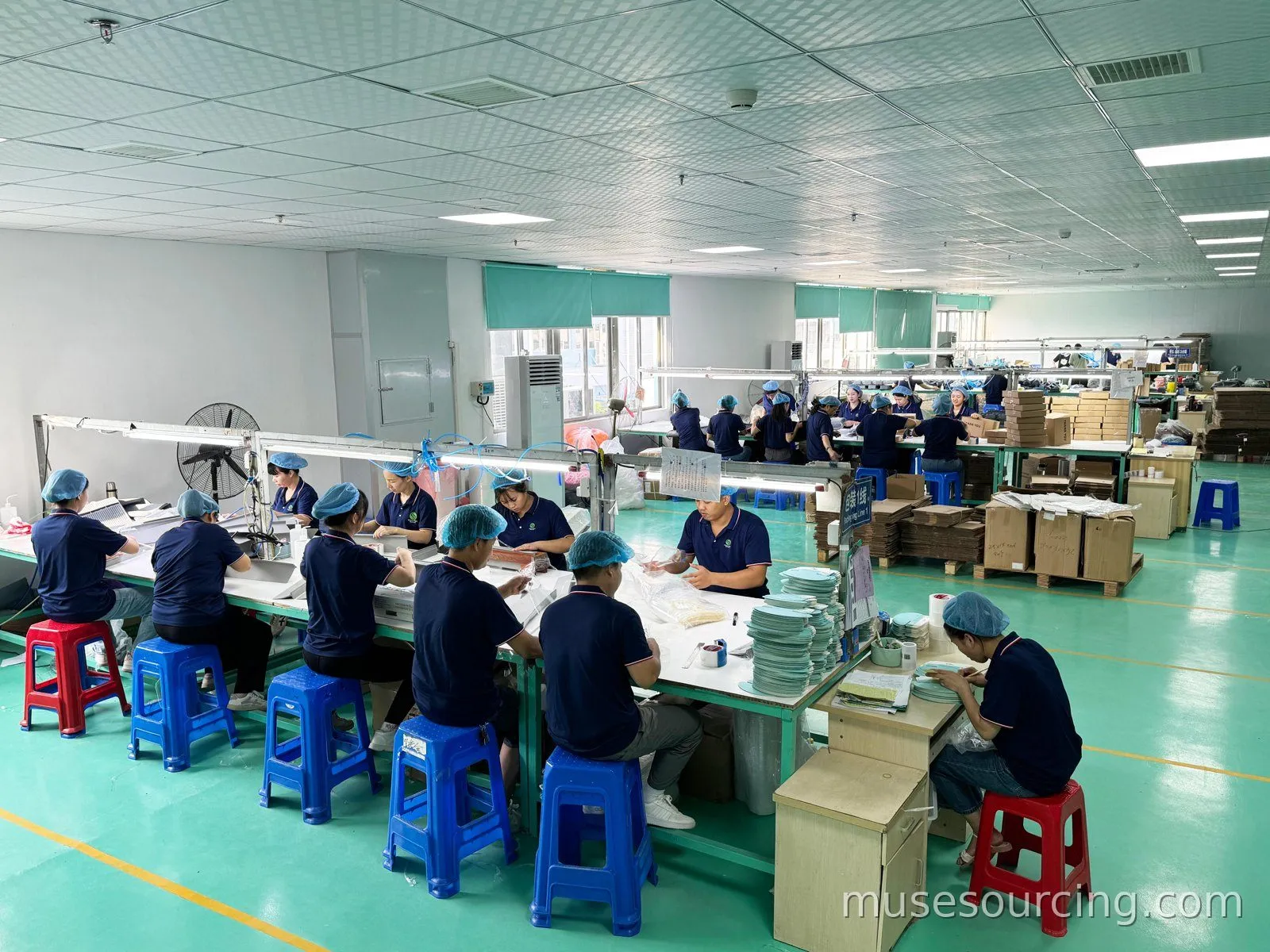
- Hand-finishing at long benches: workers trimming and packing finished pieces — the stage where flash, parting lines and surface defects are caught or missed.
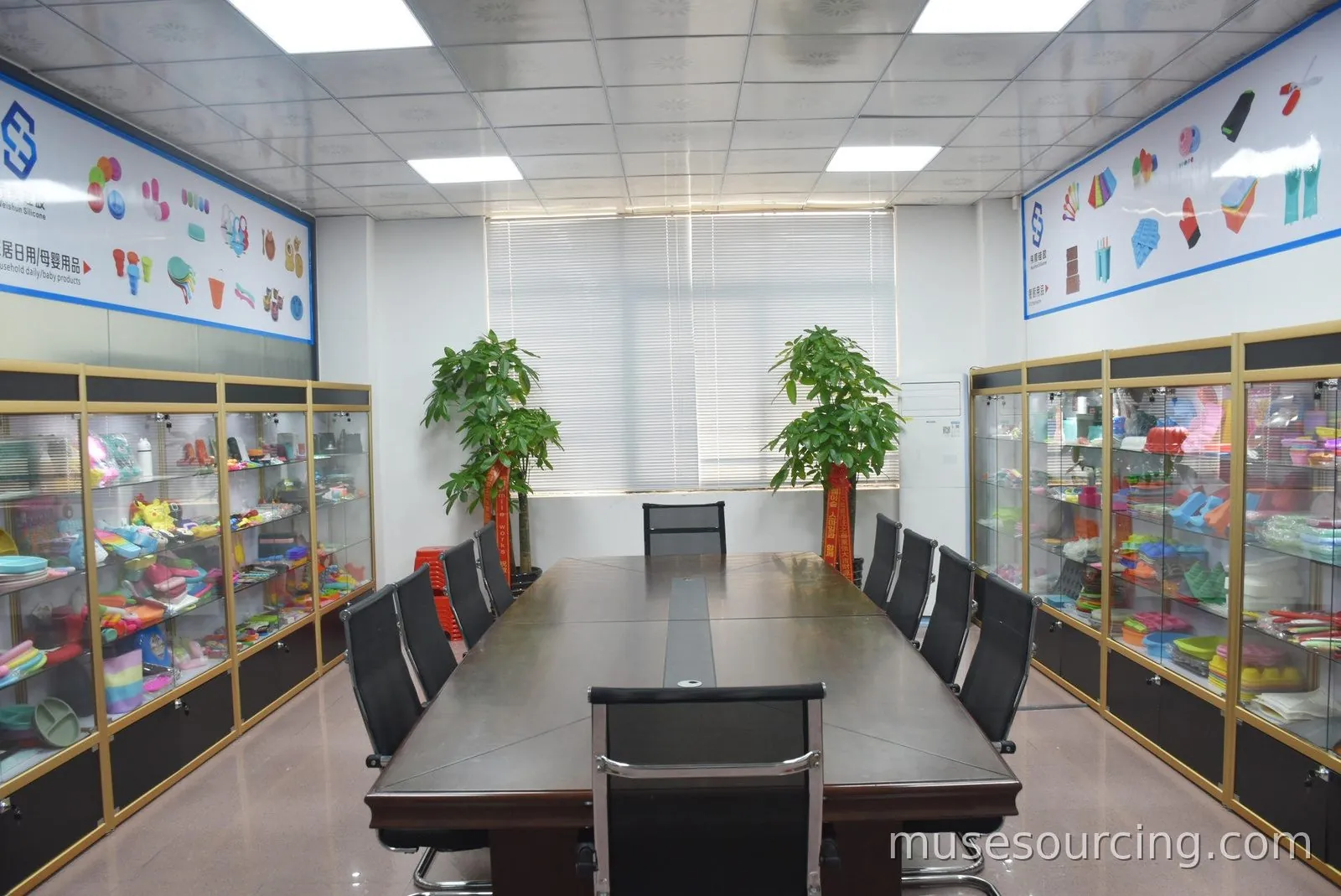
- Kitchenware showroom: moulds, utensils and storage goods on display — proof of range only; nothing in a showroom photograph is a production claim.
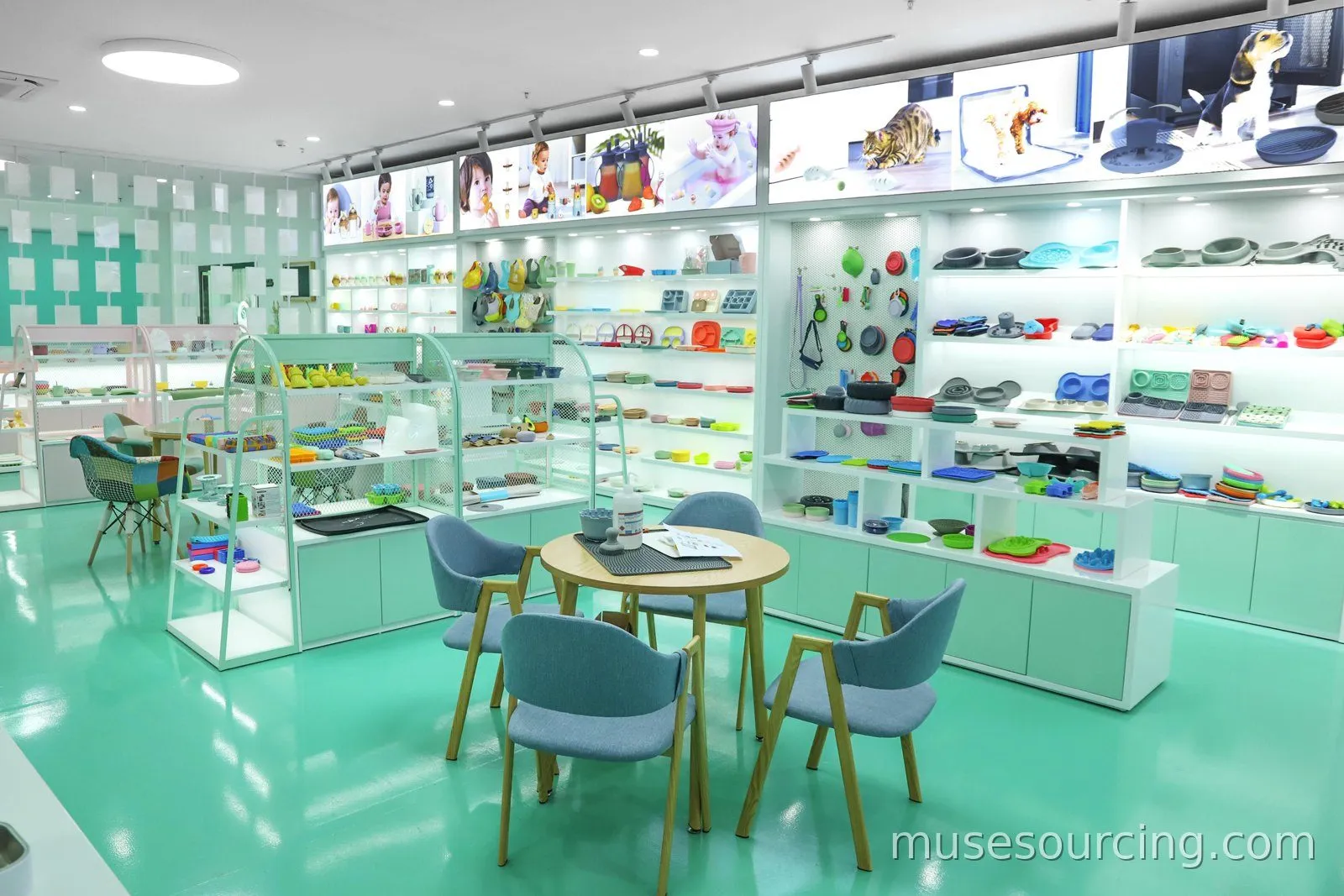
- Baby feeding showroom: bibs, bowls, spoons and teethers on display — where the range conversation starts; each article’s safety file is checked separately, before production.
Find and Verify the Right Silicone Factory
We check the manufacturer’s licence and business scope first, then how the product is actually made: whether the factory mixes its own compound, which moulding method it runs (compression or liquid silicone injection), whether moulds are made in-house or bought in, and which curing system the compound uses — platinum or peroxide. For food-contact and baby products we work to platinum-cured compound, post-cured to the compound supplier’s stated schedule (typically around 200 °C for up to four hours), and we ask for the batch’s oven record rather than an assurance that post-curing happened.
The food-grade documentation is then checked as evidence, not as decoration. A report must state its standard and its test conditions: FDA 21 CFR 177.2600 extraction for the US market; for Germany, LFGB §§ 30–31 with BfR Recommendation XV, including volatile matter of 0.5% or less after post-curing. There is no single EU-wide approval for silicone — other EU markets are checked under Regulation (EC) No 1935/2004 plus the member state’s own rules. And the report has to cover the exact compound and the production colour on your order, because the pigment is part of the compound: a report on uncoloured material covers none of your colours.
Supplier identity is disclosed on request, as a matter of policy. The full engagement — verification, sampling, production follow-up, inspection and shipping coordination — is set out on our sourcing services page.
Quality Control & Inspection: What We Check Before Shipment
Checks run on samples drawn across the production run — not on showroom pieces, and not only from the top cartons.
- Material traceability: the compound and colour in the production batch are traced through the factory’s material delivery records to the compound the verified reports actually cover — finished pieces alone cannot prove what they were moulded from.
- Odour: a screening check, never a compliance test. Samples are smelled as received and after heating; a persistent chemical odour holds the batch for a volatiles or migration test before release — and a clean smell by itself counts as nothing.
- Strength: tear and tensile figures are taken from the compound’s laboratory data sheet and test reports, not from hand-stretching finished pieces; wall thickness is checked on cut samples where the design allows.
- Temperature behaviour: baking items are held at their rated temperature for a stated time on samples, with deformation, cracking and odour after exposure recorded; the rating itself is checked against the compound supplier’s data sheet, not the factory’s listing.
- Colour and finish: colour compared with the approved physical sample across the run; mould parting lines and flash trimmed clean; hardness (Shore A — the firmness scale for rubber-like materials) checked on a flat test plaque of the same compound and batch, because a reading taken on a thin, curved piece means little.
- Utensils: the core is specified — stainless steel or nylon — with the silicone fully encapsulating it and no breakthrough at the tip or handle end; the core’s own heat rating is confirmed, because the core, not the silicone, usually sets the utensil’s real temperature limit.
- Baby products: platinum-cured compound specified, and the document set checked against the exact article before production — EN 14350 for drinking equipment and EN 14372 for feeding utensils in Europe, EN 71 where the item is a toy or teether; CPSIA limits and ASTM F963 for the US.
You receive the findings, with photographs, before the cartons are sealed.
Shipping Silicone Products from Guangdong, China
Silicone goods are light but bulky, and soft pieces deform under bad stacking — carton strength and fill decide arrival condition more than weight does. Silicone surfaces also pick up dust and lint, so how the pieces are packed matters: individually bagged or interleaved where the product needs it, checked as packed at inspection. Compression packing saves carton volume but can set a crease or a bend into soft goods over a long voyage, so any tight packing is agreed with you before the cartons close. We confirm carton dimensions during inspection, consolidate orders at our Shenzhen warehouse and coordinate FCL or LCL shipment by volume.
Frequently asked questions
How do I know the silicone is really food grade?
Ask for the test report, then check what it names. A valid report identifies the material compound, its colour and the tested product, states the standard and the test conditions, and comes from a recognised laboratory. We match reports to the compound, colour and item on your order before production, and at inspection we trace the production batch’s material delivery records back to the tested compound. “Food grade” printed on a listing is not evidence.
Why do some silicone products smell, and how is that prevented?
Odour usually means volatiles — chemical traces of the curing process — left in the material, from a cheaper curing system or a post-curing step that was shortened or skipped. Food-grade production post-cures the moulded parts to drive those volatiles off. We confirm the curing and post-cure process during verification and smell-test samples, including after heating, at inspection — a screening check that can hold a batch for laboratory testing, never a pass in itself.
Can I order custom colours or a completely new design?
Yes. Existing products can be produced in Pantone-matched colours with your logo embossed or printed. A new design needs a new mould, quoted per design by the factory — allow several weeks for mould-making before first samples, with the exact mould cost and lead time confirmed in the inquiry, before you commit to anything.
What safety documents do silicone baby products need?
Two layers. First, the food-contact reports for the final coloured article — FDA extraction testing for the US, LFGB with BfR Recommendation XV for Germany. Second, the product rules for the exact article: in Europe, EN 14350 for drinking equipment and EN 14372 for cutlery and feeding utensils, with EN 71 where the item is a toy or teether; in the US, CPSIA limits and ASTM F963. We check the full set against your article before production starts, because a missing report cannot be created after the goods exist.
What is the usual minimum order for silicone products?
Standard kitchenware and household products in standard colours can start from around 100 units as a trial order, subject to inquiry, with the unit price stepping down as quantity rises. Custom colours carry their own minimums, and new moulds are quoted separately — send us the product and colour you need, and the inquiry returns the exact figure for your specification.
Sourcing silicone products? Send the product type, colour and quantity you need, plus the destination market. An initial inquiry (flat US$200) returns 3–5 checked suppliers with real figures for your specification. Ongoing work runs at US$25–30 per hour or a fixed project fee agreed in advance, and product money goes from you directly to the factory — we are a sourcing agent, not the manufacturer, and we never hold goods money.