
MuseSourcing sources pet supplies — automatic feeders and litter systems, pet beds, cat trees and feeding accessories — from specialist partner manufacturers across Guangdong’s pet-product trade. Buyers find this page looking for a pet supplies manufacturer in China; the honest answer in this category is that there is no single one. A feeder is an electronics product, a bed is a textile product and a cat tree is a furniture product, and each is made well only by a factory that makes that thing.
What we add is the matching and the checking: each product type goes to its own specialist maker in our network, and each is inspected against the failures that product type actually has. Once a maker passes verification, we coordinate samples, follow production, inspect finished goods and arrange consolidation and shipment.
Sourcing base: Guangdong’s pet-product trade — ranges held by partner suppliers across the province, consolidated and shipped from Shenzhen. This is a category with no single manufacturing cluster.
See all the categories we work in: Products We Source from China
Key takeaways
- One generalist supplier for a mixed pet range is how quality quietly averages down. Feeders, beds and cat trees fail in completely different ways, and each needs its own specialist maker and its own checklist.
- Pet products ship a lot of air. Carton volume — not weight — is usually the biggest cost in the order, so finished cartons are measured and freight is priced on real dimensions, not catalogue figures.
- Anything a pet chews, licks or sleeps on is a material question first. Pet-contact material documents are checked before sampling, not after the goods exist.
What we source in this category
- Automatic pet feeders and water fountains, litter boxes and litter systems
- Pet beds, tents, mats and soft furnishings
- Cat trees, towers and scratching furniture
- Feeding bowls and feeding accessories
- Pet toys and small accessories
- Private-label branding and retail packaging across the range; the same makers run wholesale pet supply lines for overseas pet brands and retailers
Real Partner Photos: The Ranges We Source From
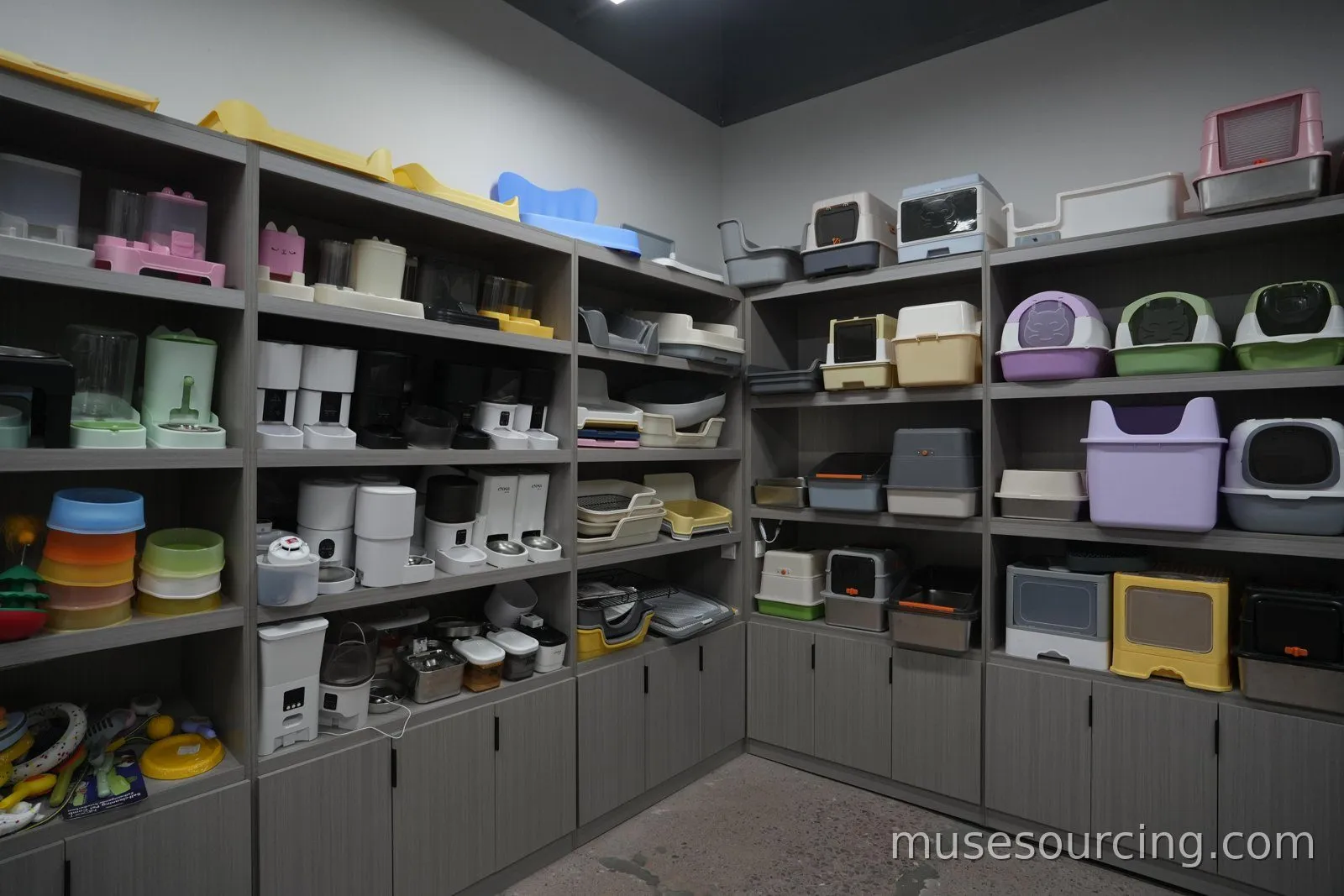
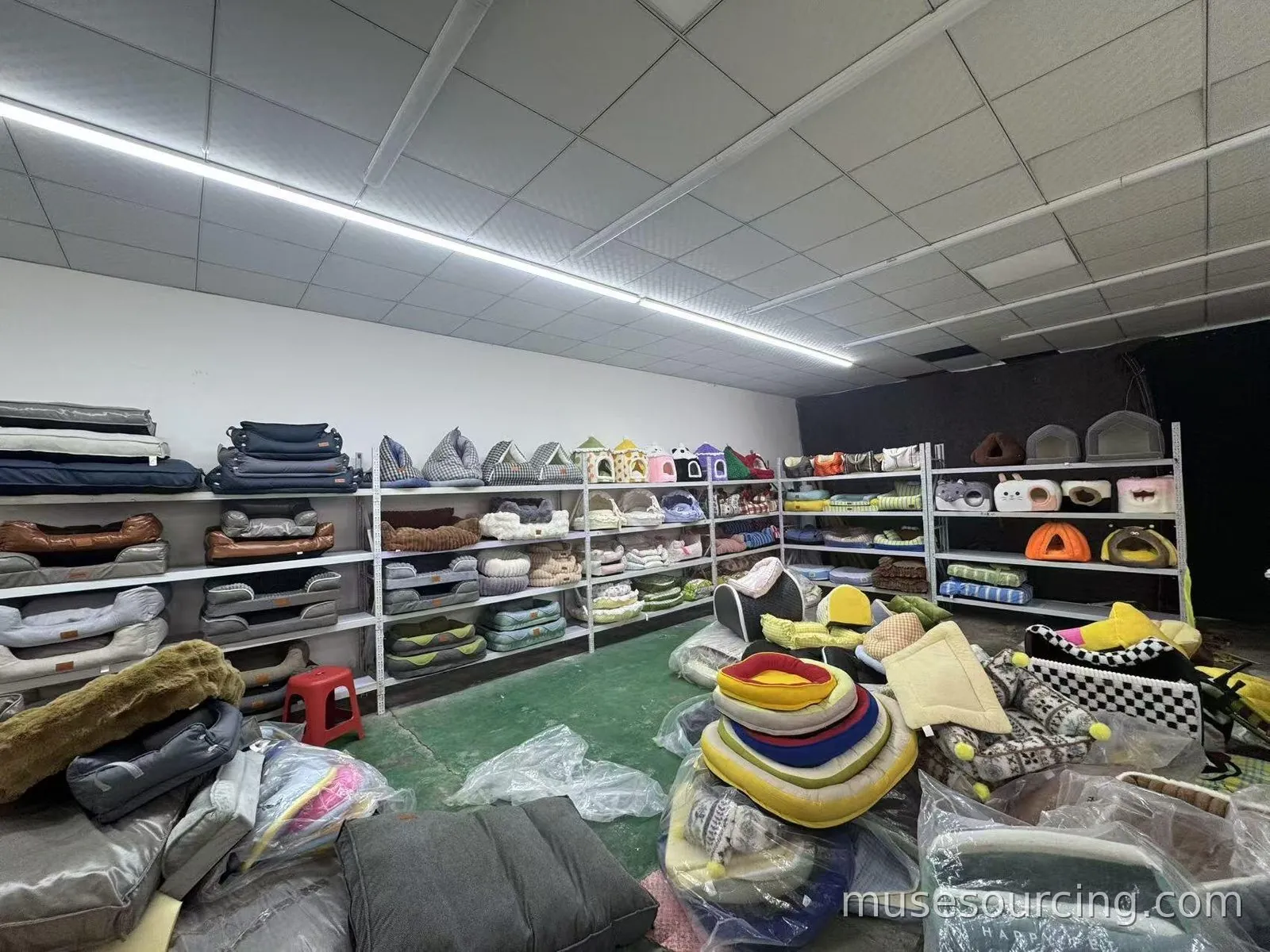
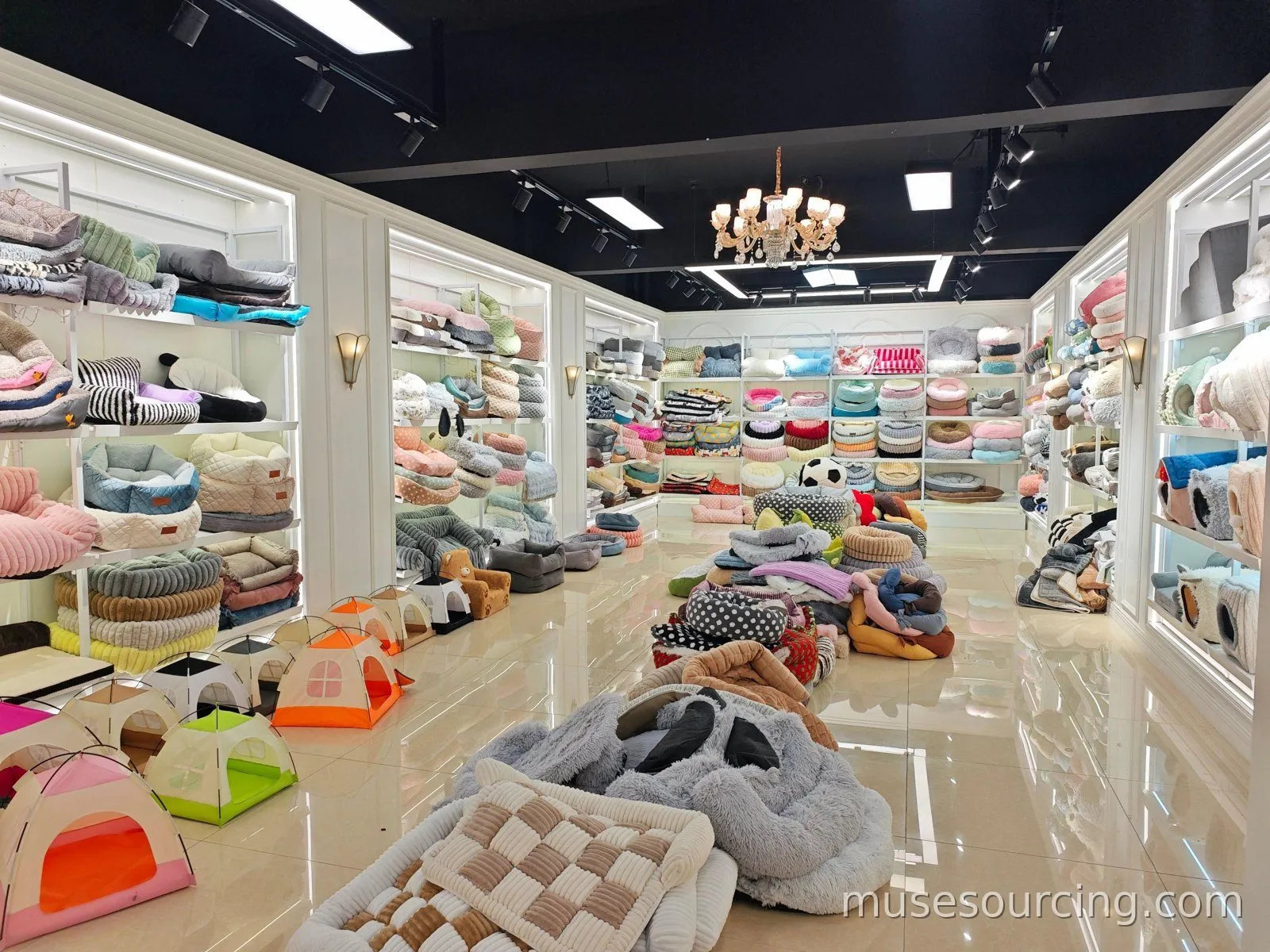
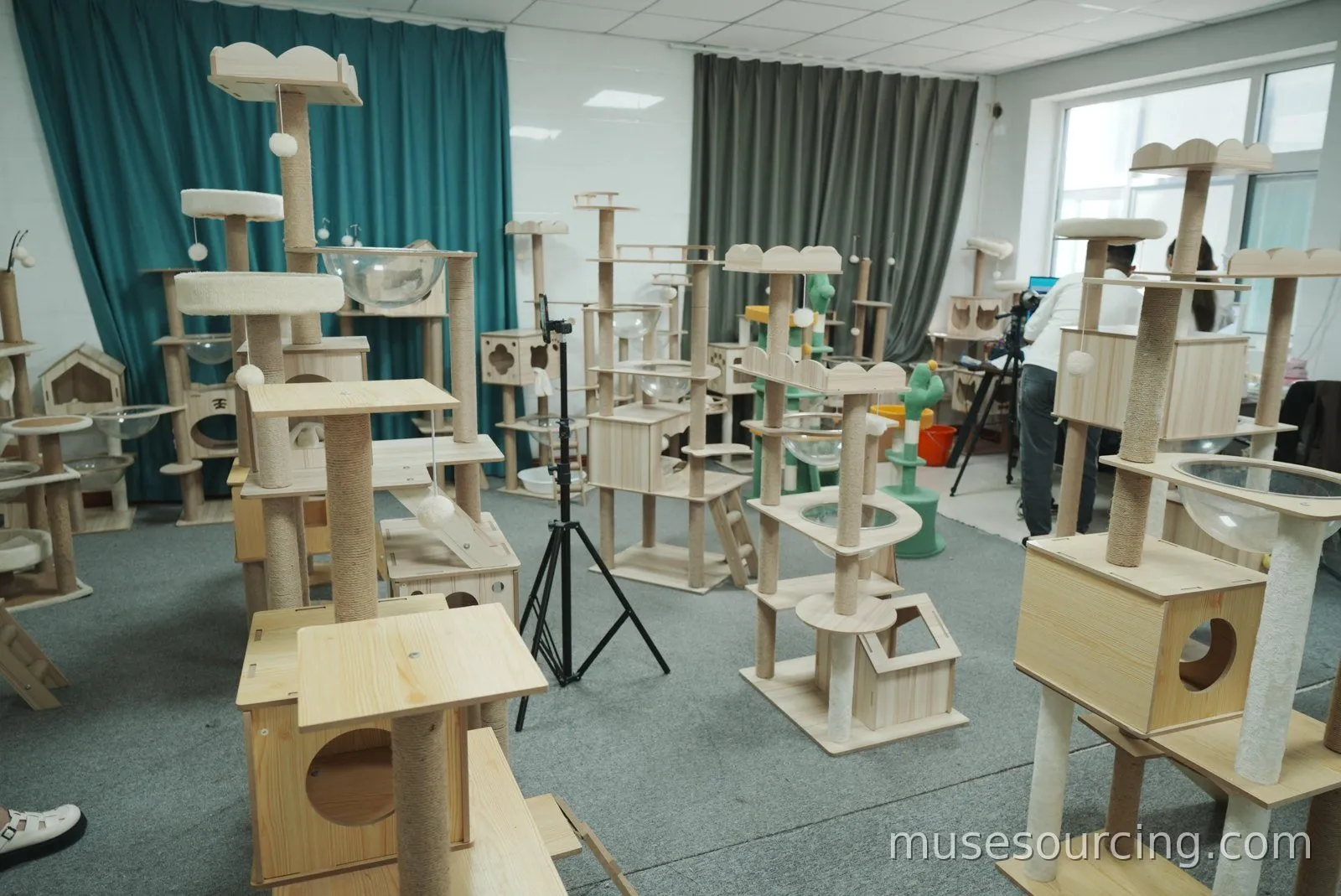
Real photos from our partner suppliers’ showrooms and stock areas — the ranges we source from, photographed where buyers compare them, not AI-generated or library images. Each specialist maker is verified, and its finished goods inspected, at its own premises.
- Feeders and litter systems on showroom shelves: the electronics end of the range — models compared side by side before sampling starts.
- Pet beds in stock: soft goods held in depth, where filling and fabric consistency across a batch can be compared by hand.
- Beds and tents on display: the textile range as buyers see it — construction and seam quality are then checked on sampled pieces, not on the display set.
- Cat trees in the showroom: wooden towers and climbing frames at full size — the only honest way to judge stability is assembled, which is how we test sampled units.
Find and Verify the Right Maker for Each Product
We check each maker’s licence and business scope first, then match the product to the maker’s actual production: the feeder maker is verified as an electronics producer, the bed maker as a textile producer, the cat tree maker as a furniture producer. Material safety documents for pet-contact surfaces are collected at this stage and read against your destination market’s rules: food-contact test reports for bowls and feeder parts that touch food and water, and declarations covering dyes and formaldehyde for fabrics, fillings and boards — with a supplier’s own declaration recorded as a declaration, not as a lab report. OEM/ODM and private-label programmes are compared across 3–5 checked suppliers per product type, with the supplier’s identity available to you on request.
Quality Control & Inspection: What We Check Before Shipment
- Feeders and fountains: dispensing accuracy weighed across a full-to-near-empty hopper, not just the first portions, and jam behaviour tested with a typical kibble size; app pairing, timer function and whether the schedule survives a power cut; what the battery backup actually powers; plug, voltage and adapter matched to your market; on fountains, water-path sealing, pump noise and filter fit. Bowl and hopper materials are checked against their claims — stainless grade, food-grade plastic — not taken from the listing.
- Litter systems: on automatic boxes, rake and sensor cycles run repeatedly, cat-detection and anti-pinch stopping tested, and waste-drawer sealing checked, because odour complaints are what bring these units back.
- Beds and soft goods: seam and stitching strength pulled on samples, filling weight and distribution against the approved sample, odour on opening, loft recovery after vacuum compression, zip cycles and slider pull, fabric colour fastness.
- Cat trees: assembled stability under load — rock and weight tests on a built unit — post-joint strength, base-board thickness and flatness, sisal glue hold and rope ends (tight wrapping that is not glued unravels), covering checked for shedding and exposed staples, and the complete hardware set counted on every pack we open.
- Material safety: the documents collected at verification are re-matched to the actual products in the order before release — reports, not just declarations, where a product touches food or water; small detachable parts are pulled and checked on toys and accessories.
- Volume and packing: carton dimensions measured on finished packing — a few centimetres per carton compounds across a container — flat-pack protection and instruction sheets checked.
Shipping Pet Supplies from Guangdong, China
Pet orders are usually mixed orders — feeders, beds and trees from different makers — and they are volume orders: the freight is mostly air inside big cartons. We consolidate the makers’ goods at our Shenzhen warehouse, confirm the combined carton volume before booking, and coordinate FCL or LCL shipment against the measured figures rather than the catalogue ones. The loaded-carton photos you approve become part of the shipment record.
Frequently asked questions
Can one supplier provide my whole pet range?
One supplier can sell you the whole range, but it will manufacture only part of it and buy the rest in — which means nobody is checking the parts it bought. We place each product type with a specialist maker and run the orders as one consolidated shipment, so you get one point of contact without giving up the specialist production.
How is material safety for pet products checked?
Before sampling, we collect the material documents for anything a pet touches, chews or eats from, and read them against your market’s rules: food-contact test reports for feeder and bowl parts, declarations for fabrics, fillings and boards. They are matched to the actual products in your order — a certificate for a different product covers nothing, and a supplier’s own declaration is never treated as a lab report.
How do you check a cat tree is stable enough?
On an assembled sample, not from photographs. We load and rock the built unit, test post joints and base board, check the sisal’s glue hold and rope ends, and count the complete hardware set on the packs we open — a missing bracket set is the most common complaint in this product type, and it is entirely preventable.
Why does freight cost more than expected for pet products?
Because the cartons are large and light: beds, trees and litter systems take container space out of proportion to their weight, and carriers charge for the space. We measure finished cartons during inspection and price the shipment on real dimensions before booking, and where a design can flat-pack or nest better, we raise it before production rather than after.
What is the usual minimum order for pet supplies?
Standard products can start from around 100 units as a trial order, subject to inquiry, with the unit price stepping down as quantity rises. Fully custom designs, colours and app-linked products set their own minimums, and bulky items such as cat trees are often more practical by carton or container quantity — send us the products you need, and the inquiry returns the exact figure for your specification.
Sourcing pet supplies? Send the product types and quantities you need. An initial inquiry (flat US$200) returns 3–5 checked suppliers with real figures for your specification.