
MuseSourcing sources rice cookers — conventional, digital multifunction and mini models — together with electric kettles and other small kitchen appliances, from partner factories in Foshan’s Shunde district and Zhongshan. Buyers find this page looking for a rice cooker manufacturer in China; what we add to that factory is the verification layer described below. Appliance quality rarely fails all at once. It drifts: a thinner inner-pot coating, a thermostat that cuts out early, a run that heats unevenly from the first carton to the last. Our inspections sample across the whole run rather than from the first cartons off it. Once a factory passes verification, we coordinate samples, follow production, inspect finished appliances and arrange consolidation and shipment.
Manufacturing hub: Guangdong — China’s small-appliance heartland; Shunde in Foshan and Zhongshan are its best-known clusters. The partner factories we use assemble and pack on their own lines.
See all the clusters we work in: Products We Source
Key takeaways
- The inner pot is where rice cooker quality is won or lost: coating thickness and adhesion decide whether the pot is still non-stick in year two. We check the coating specification and test it on run samples.
- An appliance certificate belongs to an exact model. A certificate for a sister model with a different heating plate or control board is treated as no certificate.
- Consistency across the run is the real specification. Thermostat behaviour, heating and keep-warm performance are sampled from the beginning, middle and end of production — not from the golden sample.
What we source in this category
- Electric rice cookers: conventional mechanical models and digital multifunction cookers, on heating plates or induction (IH); mini sizes from around 0.6L, family sizes up to 1.8L, and commercial capacities of 5L and above
- Electric kettles and small heating appliances from the same factory lines
- Multi-cookers and steamers from the same partner factories
- Custom (OEM/ODM) programmes: colours, control-panel languages and private-label branding and packaging; the same factories supply wholesale appliance lines for importers and retail brands
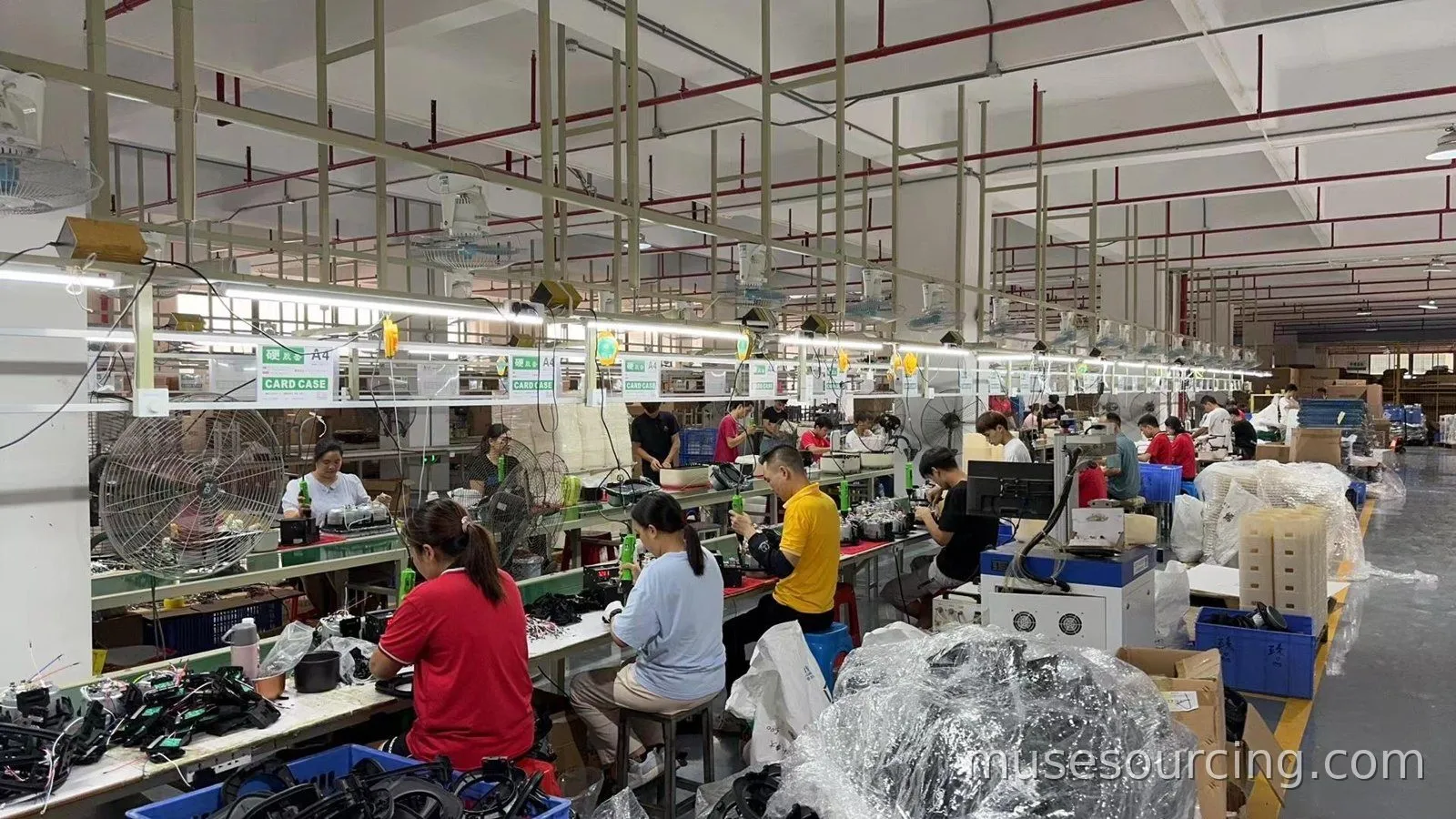
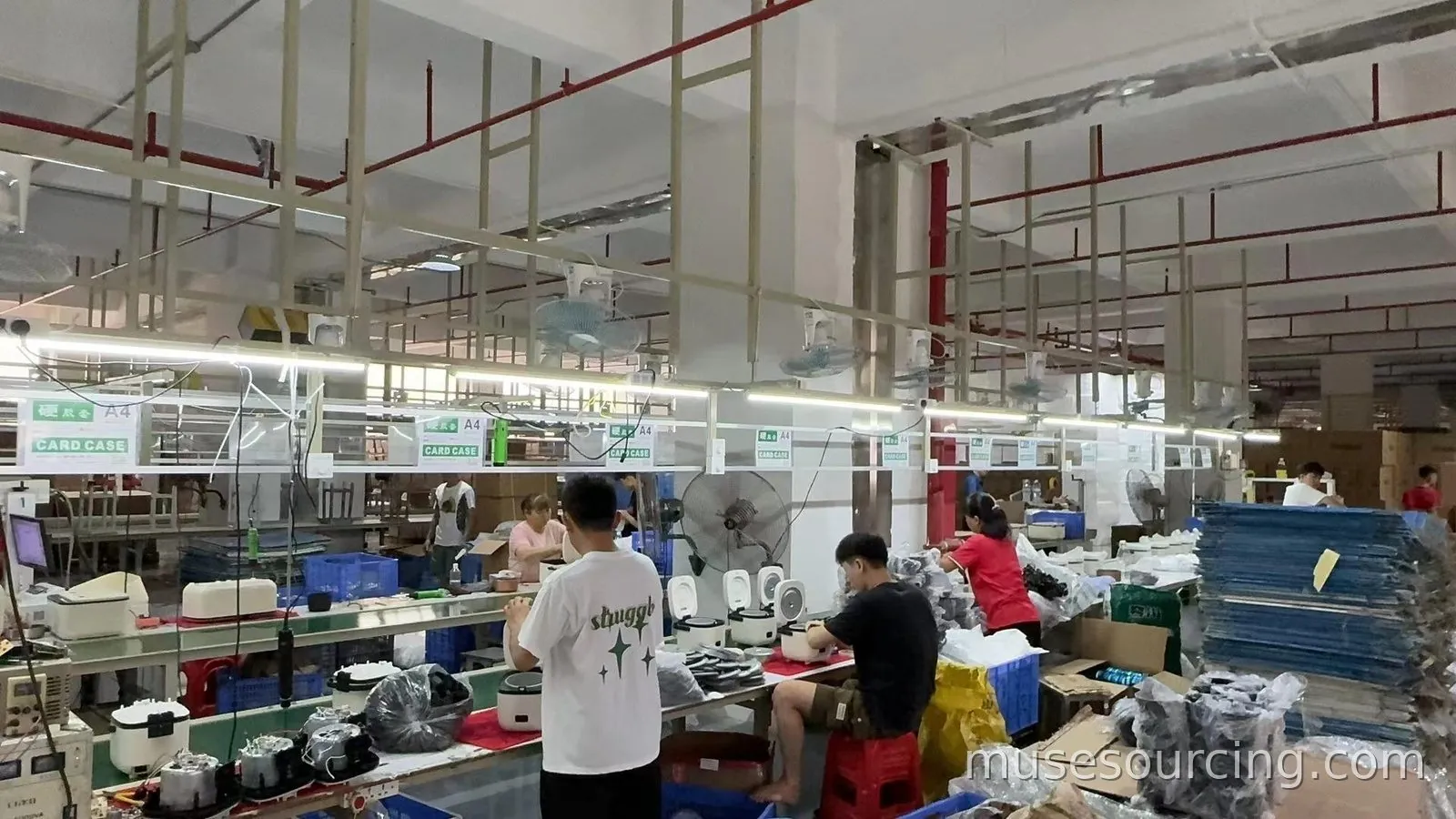
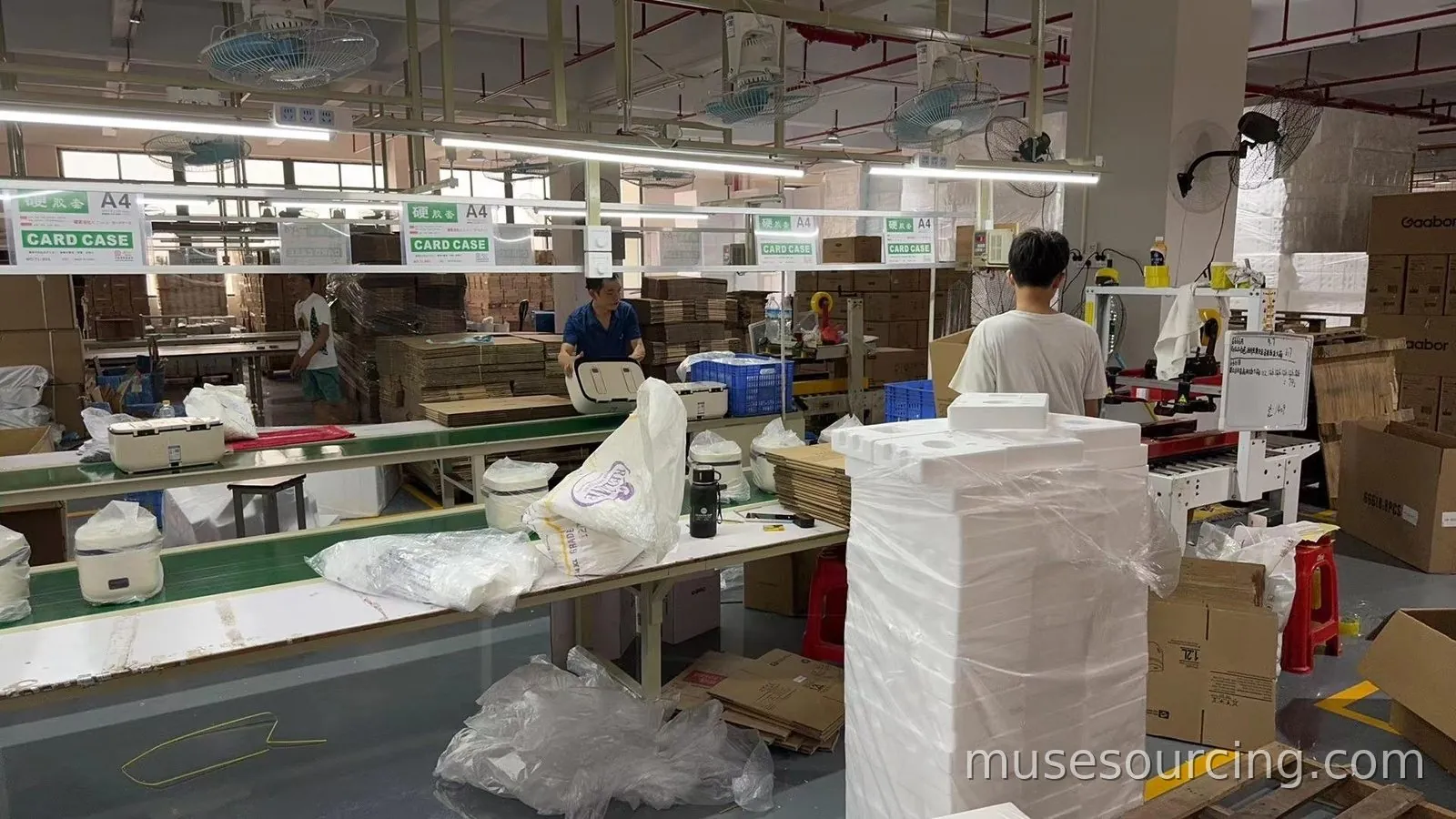
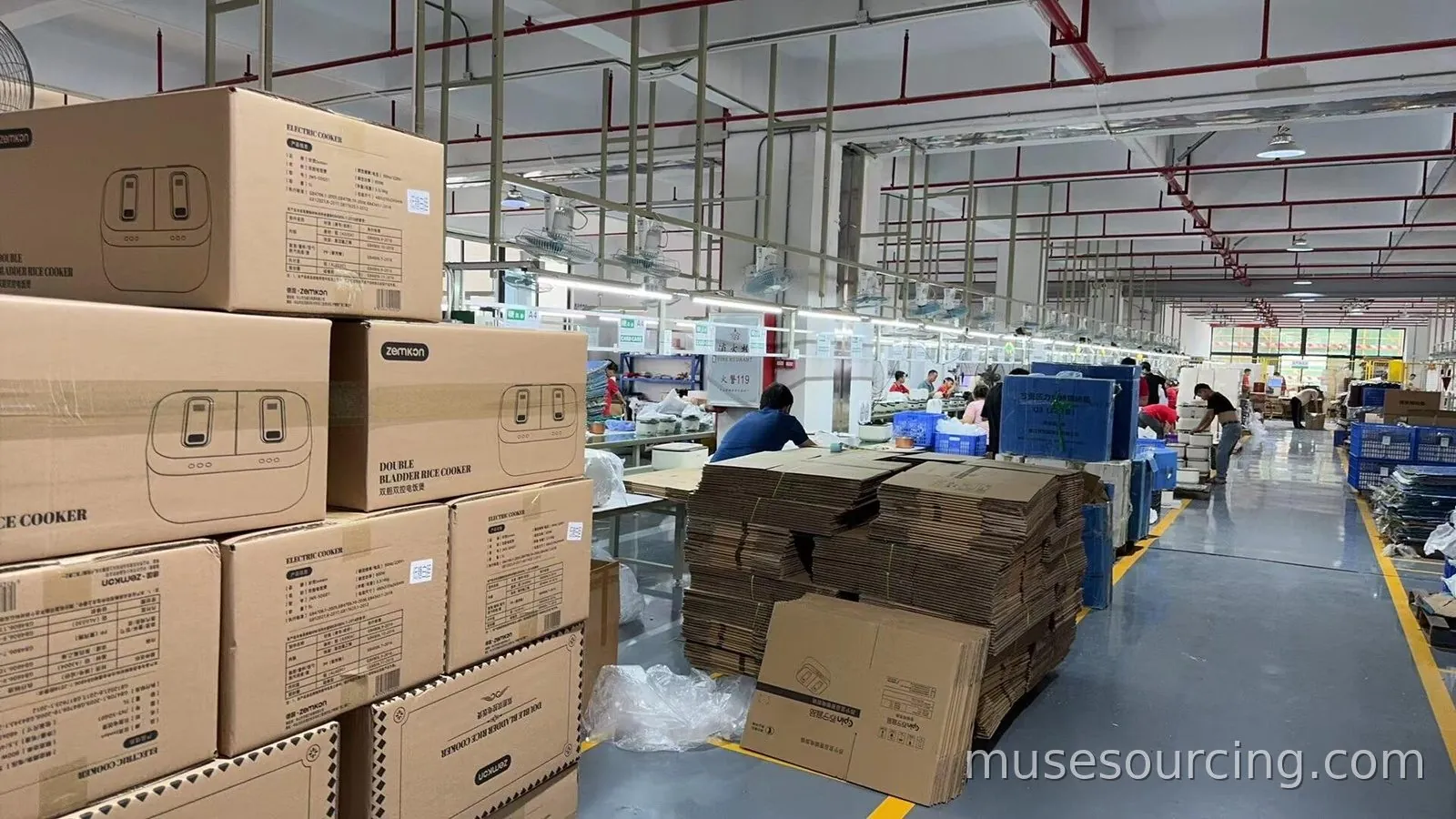
Real Factory Photos: Assembly and Packing Lines in Guangdong
Real partner-factory photos — not AI-generated or stock imagery.
- Assembly and packing line: rice cookers assembled and packed on the partner factory’s own line — proof the offer is backed by a working production line, not a trading desk.
- Packing lines for small appliances: finished units moving through packing, where plug, manual and accessory sets are completed for the destination market — the step that decides whether a carton arrives market-correct.
- The packing area: foam inserts and cartons staged beside finished cookers — proof carton protection is built into the packing specification here, not improvised at loading.
- Cartons beside the production floor: finished goods staged before consolidation — where carton dimensions and stacking are confirmed before freight is booked.
Find and Verify the Right Rice Cooker Factory
We check the manufacturer’s licence and business scope first, then confirm that the assembly lines belong to the company making the offer — not a landlord, a neighbour or another factory in the same park. Shunde and Zhongshan matter because the heating-element, thermostat and plastics trades sit inside the same cluster: the components behind a cooker are sourced in the same streets as the line that assembles it.
The certificate files are checked model by model, market by market. For Europe, CE marking is the manufacturer’s own declaration, and it stands or falls on the LVD and EMC test reports behind it — plus RoHS, and food-contact evidence for the inner pot and its coating, which touch the food. For the United States, the exact model needs its own safety listing (UL or ETL) to the applicable standard; a CB test report can support that file but approves nothing by itself, and Germany’s GS mark is a voluntary extra some channels ask for, never a legal requirement. A file for a sister model — different heating plate, control board or market voltage — is treated as no file: a small kitchen appliance supplier who cannot produce the file for your model does not ship to our clients until that is fixed.
The supplier’s identity is available to you on request.
Quality Control & Inspection: What We Check Before Shipment
- Inner pot: the coating system (fluoropolymer or ceramic), its layer count and dry-film thickness in microns are written into the specification before production. On run samples we run cross-hatch adhesion and abrasion checks, compare the pot against the approved sample, and check pot fit, substrate and lid seal.
- Heating and thermostat: cooking tests on run samples — actual rice and water, not an empty switch-on — with thermostat cut-out observed across a full cook cycle; keep-warm temperature measured at the centre and edge of the pot after 30 minutes and again after two hours, against the band agreed in the specification.
- Fail-safes: dry-cook protection and thermal-fuse operation tested on samples. On digital models, the temperature sensor’s readings are compared against a reference thermometer, and the steam path, detachable inner lid and condensation collector are checked.
- Electrical safety: rating label, plug and voltage matched to your market. Hi-pot (dielectric strength) and earth-continuity tests run on every unit on the factory’s own line — we witness the test station, check the tester’s settings and calibration, and re-test units from the inspection sample, earth continuity included, within the safety standard’s 0.1 Ω limit for Class I construction.
- Energy and function: power draw checked against the rating label, every control function worked through on sampled units, including panel language and markings.
- Ageing and consistency: sampled units run repeated full cook-and-keep-warm cycles at rated voltage, and heating and keep-warm behaviour is compared across the sample for drift.
- Kettles and other heating appliances: controller type confirmed (branded controllers of the Strix type where the specification calls for one), boil-dry cut-out and automatic shut-off on boiling tested, spout pour and lid fit checked.
- Packing: accessory and manual sets counted — including spare inner pots and sealing rings where they form part of the order — carton drop behaviour checked on finished packaging, and barcodes and labelling verified before cartons close.
Shipping Small Appliances from Guangdong, China
Carton dimensions and foam protection decide both freight cost and arrival condition for appliances — a cooker is mostly boxed air wrapped around a heating element. We confirm carton dimensions and packing during inspection, consolidate orders at our Shenzhen warehouse and coordinate FCL or LCL shipment by carton count. Certificate files and test reports travel in the shipping dossier, collected during verification rather than chased at departure.
Frequently asked questions
Can the cookers be made for my market’s plug, voltage and frequency?
Yes — but a market version is an engineering variant, not a plug swap. The heating element is rated for the market’s voltage (100V, 120V or 230V), so a US or Japanese version is effectively a different model, with its own certificate file and often its own minimum quantity. Plug and voltage are fixed in the specification at sampling. At inspection, rating labels and plugs are checked on every unit in the inspection sample, because a correct factory can still pack a wrong-market carton.
What safety certificates should a rice cooker have?
It depends on the market — and always on the exact model. For Europe: CE marking backed by LVD and EMC test reports, RoHS, and food-contact evidence for the inner pot and its coating. For the United States: the model’s own safety listing (UL or ETL) to the applicable standard. A CB test report can support an application but is not an approval, and Germany’s GS mark is voluntary. We match the file to the model, voltage variant and heating configuration on your order before production — a certificate for a similar model does not cover yours.
How do you check the non-stick inner-pot coating?
The coating system, layer count and dry-film thickness go into the written specification before production — a verbal “same as sample” cannot be enforced once the run starts. On run samples we run cross-hatch adhesion and abrasion checks and compare the pot with the approved sample. If a quote does not state the coating system and thickness, get both in writing before you compare prices.
Can I brand the cooker and print the control panel in my language?
Yes. Logo printing, housing colours, control-panel languages and private-label retail packaging are standard OEM work for these factories. Panel artwork and marking are approved on a production sample before the run.
What is the usual minimum order for rice cookers?
For an off-the-shelf model in its standard specification, trial orders can start from around 100 units as a trial order, subject to inquiry, with the unit price stepping down as quantity rises. A market-specific voltage, a custom panel language or your own packaging makes a different variant with its own minimum — send us the model and market you need, and the inquiry returns the exact figure for your specification.
Sourcing rice cookers or small appliances? Send the model, your destination market and estimated quantity. An initial inquiry (flat US$200) returns 3–5 checked suppliers with real figures for your specification.